TRADUCTOR TRANSLATOR

miércoles, 18 de octubre de 2017

La Negación de San Pedro


Seguidor de ROMBOUTS, Theodoor (Amberes, 1597-1637).
“La Negación de San Pedro”. Siglo XVII.
Óleo sobre lienzo.
Medidas: 95 x 19 cm; 116 x 139,5 cm (marco).
La presenta obra muestra una composición muy elaborada, con una gran cantidad de figura en variadas actitudes recortadas sobre un fondo neutro, con un marcado contraste entre luces y sombras y un uso teatral de la iluminación. Este detalle, junto con los tonos escogidos en el lienzo, vincula la presente obra con los seguidores en estilo de Caravaggio, conocidos como caravaggistas. 
Temáticamente, se muestra el tema bíblico de la Negación de San Pedro, relacionado con el Ciclo de la Pasión de Cristo y que aparece en el Nuevo Testamento.
Es preciso destacar la cercanía a la obra del mismo tema (aunque hay variantes) realizada por Gerard Seghers hacia 1620-1625, conservada en la actualidad en el North Carolina Museum of Art (Estados Unidos). 
Theodoor o Theodore Rombouts fue un pintor flamenco del Barroco especializado en escenas de género, siguiendo el estilo caravaggista, influenciado por los pintores de esta tendencia que se habían establecido en Roma. 
Se formó en Amberes, primero con Frans o Franchois van Lanckvelt y después con Abraham Janssens (siendo posible que también estudiara con Nicolas Régnier). Viajó a Roma en 1616, quedándose para ampliar sus conocimientos en la ciudad hasta 1625: posiblemente, conoció en Florencia a Bartolomeo Manfredi, y quizá trabajó para Cosme II de Médici; en 1622 estuvo también en Pisa. 
A su vuelta a Amberes en 1625 ingresó en la Cofradía de San Lucas de pintores de la ciudad, y se casó con la hermana de Jan Philip van Thielen. Entre 1628 y 1630 ostentó un cargo de importancia en esa misma cofradía, y en 1635 colaboró con otros artistas en el programa de las decoraciones de la Gloriosa Entrada del Cardenal Infante Fernando en Amberes, bajo la dirección de Rubens.
Entre sus discípulos es preciso destacar a Nicolaas van Eyck, Jan Philip van Thielen y Paulus Robyns. Su trabajo se conserva sólo en algunas colecciones privadas de importancia en todo el mundo y en importantes instituciones como el Museo del Prado de Madrid, el Real Museo de Bellas Artes de Amberes, el Philadelphia Museum of Art de Estados Unidos, el Hermitage Museum de San Petersburgo, etc.

Escenas de la vida de San Blas


Escuela aragonesa, siglo XVI.
Escenas de la vida de San Blas
Óleo sobre tabla.
Medidas: 161 x 112 x 11 cm.

En esta obra vemos a la figura de san Blas acompañada por escenas de su vida. La pintura fue realizada por un artista aragonés que hibrida los esquemas aprendidos de los últimos maestros góticos con las nuevas tendencias renacentistas. Así, se mantiene la estructura de retablo propia de la edad media hispánica, con una “calle” o tabla central más ancha y alta, ocupada por la figura del santo titular, y dos “calles” laterales distribuidas respectivamente en dos “casas” o compartimentos, ocupadas por escenas narrativas. Pese a esta estructura tradicional, el artista muestra un gran interés por el paisaje, que ocupa algunos de los fondos de sus escenas, y por la perspectiva, que le ayuda a componer algunas de las escenas. El tratamiento de las ropas, por otra parte, renuncia a las telas de aspecto grueso y almidonado, con pliegues quebrados, propio de la pintura de filiación flamenca, para adoptar pliegues naturales y suaves, que se ciñen al cuerpo revelando la anatomía subyacente. 
En el centro se encuentra el santo con sus atributos del martirio, vestido con ropas clericales. Vemos cómo se sitúa en una estancia con un pavimento geométrico utilizado para construir el espacio en perspectiva, y tras él aparece una tapia que se abre para mostrarnos un paisaje. Este esquema compositivo se repite de igual forma en otras obras del gótico aragonés, como la representación de san Blas de la tabla central del retablo de la iglesia de San Salvador en Luesia (Zaragoza), pintada por Martín de Soria.
A los lados de la imagen central de la tabla tenemos otras cinco escenas. La primera comenzando por la esquina superior izquierda nos muestra al santo en un entorno de paisaje, rodeado de animales a los que está bendiciendo. Esta escena alude al hecho de que san Blas es conocido por sus curaciones no sólo a personas, sino también a animales. Debajo de esta imagen vemos al santo asomado a una ventana, bendiciendo también a una mujer, probablemente para propiciar su curación. En la esquina superior derecha aparece el santo frente a una autoridad que le va a juzgar por no rechazar la fe cristiana. Seguidamente, en la escena inferior, vemos el martirio del santo. Sus verdugos arrancan la piel del santo con unos cardadores de lana metálicos, como narra la hagiografía. Finalmente una última escena corona la obra, un Calvario que representa a Jesús en la cruz, con la Virgen y san Juan Evangelista a sus pies. Esta escena es la única que no ilustra la vida de san Blas, y responde a un deseo de ensalzar y defender la fe a través de la propia vida, ya sea en la vida de Cristo, terminada con la Pasión, o la de san Blas, culminada en su martirio.
San Blas fue un médico y obispo de finales del siglo III y principios del IV, que vivió en la ciudad de Sebaste, en la actual Armenia. Hizo vida eremítica en una cueva del bosque del monte Argeus, que posteriormente se convertiría en su sede episcopal. Durante la persecución contra los cristianos de principios del siglo IV fue hallado en esta cueva y apresado. Se le insistió en renegar de su fe, y estando en prisión enfureció al pretor tras sanar a los presos que se encontraban con él, por lo que fue condenado a muerte y arrojado a un lago. Sin embargo, el santo sobrevivió al caminar sobre las aguas, mientras que sus verdugos perecieron. Su martirio llegaría entonces de forma más sanguinaria, pues fue ejecutado mediante cardadores metálicos del tipo utilizado para trabajar la lana, que como rastrillos desagarraron su piel hasta que murió desangrado. Este martirio fue aplicado también a un grupo de mujeres que, al igual que san Blas, se negaron a rechazar su fe. El culto a san Blas se extendió por todo Oriente, y más tarde también por Occidente. Es actualmente considerado patrono de los enfermos de garganta y los otorrinolaringólogos, además de ser patrono del Paraguay, de diversas ciudades españolas y de Dubrovnik, en Croacia, donde su festividad se remonta como mínimo al año 1190.

San Juan Bautista


Escuela Romana, hacia 1600
"San Juan Bautista"
Óleo sobre tabla.
Medidas: 75 x 55 cm; 97,5 x 72 cm (marco)

San Juan Bautista porta un bastón con una cinta enlazada en la que se leen las palabras que pronunciadas al reconocer a Jesús en el río Jordán: "Ecce Agnus Dei" ("He aqua el Cordero de Dios"). El cordero que lo acompaña simboliza a Cristo. La armonía compositiva y cromática, el justo equilibrio entre la belleza ideal del clasicismo que refleja el canon corporal y la fidelidad a una lógica veraz en las adustas facciones, entre la perspectiva lineal y atmosférica, así como la dignidad que emana del interior del personaje, sólo puede responder a un pintor que conoce la pintura de Rafael.

Cristo de la Humildad y la Paciencia


Escuela española del siglo XVII. Círculo de MURILLO, Bartolomé Esteban (Sevilla, 1617 – Cádiz, 1682).
“Cristo de la Humildad y la Paciencia”. 
Óleo sobre lienzo. 
Medidas: 49 x 37 cm; 60 x 47 cm (marco).
Obra atribuida a Bartolomé Esteban Murillo, según estudio de Dr. José Piñol Barrull, emitido en 1999. 
Medidas: 32 x 22 cm; 40 x 30 cm (marco).
Según defiende el crítico de arte Dr. José Piñol Barrull, podría tratarse de un boceto realizado por el propio Murillo para un cuadro posterior.
Imagen devocional en la que se representa la imagen del Señor de la Humildad y la Paciencia, tema iconográfico procedente del norte de Europa y difundido por zonas meridionales a partir del siglo XV. La manifestación de la tristeza de Cristo en dicho tema iconográfico se vincula con el llamado “Temperamento saturnino”, a su vez relacionado con las iconografías alemanas del Varón de Dolores, que Durero plasmó en sus grabados de la pequeña y gran Pasión. 
El artista, perteneciente al círculo del maestro Bartolomé Esteban Murillo, representa a Jesús profundamente abatido y triste, sedente sobre una caja, esperando el momento decisivo de la Crucifixión. De esta manera, apoya su cabeza sobre su mano izquierda, mientras medita sobre los tormentos recibidos y las angustias que le abordan. En esta ocasión se representa a Cristo ante un fondo austero, neutro, si bien en otras ocasiones se le representa absorto entre la multitud. 
Se trata de una imagen de hondo dramatismo, típicamente barroco, realzado por la expresión de su rostro. La atmósfera atormentada en que respira Cristo plasma un personaje ensimismado, con una intensa vida interior, lleno de melancolía y renunciamiento ascético, propio de las doctrinas contrarreformistas que convirtieron a Murillo en el pintor de la Contrarreforma. La pieza presenta los trazos delicados que configuran la belleza característica de Murillo, cuya suavidad y dulzura enmarcan la obra dentro de la escuela sevillana. 
La influencia de Murillo fue clave para el desarrollo del pleno barroco no sólo en la escuela sevillana, sino también en otros focos. Considerado por algunos como el pintor que mejor define el barroco español, este maestro ejerció una notabilísima influencia entre sus contemporáneos sevillanos y, tras su muerte, su estela puede hallarse en otras escuelas incluso hasta el día de hoy, especialmente en lo referente al arte religioso. En el siglo XVIII su lenguaje y sus fórmulas iconográficas serán muy seguidos y repetidos, y durante el Romanticismo se realizaron numerosas copias de sus obras. No obstante, será en el barroco del siglo XVIII cuando más se aprecie la importancia de su influjo, difundido por sus numerosos discípulos y seguidores. De hecho, en dicha centuria fue el pintor español más conocido y apreciado fuera de España, el único del que Sandrart incluye una biografía en su “Academia picturae eruditae”, una obra de finales del siglo XVII.

Ecce Homo


Escuela española del siglo XVIII.
“Ecce Homo”.
Pintura sobre vidrio.
Marco de época.
Medidas: 33 x 29 cm; 50 x 33 cm (marco).

Imagen devocional barroca española, realizada en el siglo XVIII sobre vidrio, lo que dota a los colores de una especial transparencia y luminosidad. Se trata de la representación del Ecce Homo, con Jesús de busto, con rostro sufriente y resignado, cubierto por las gotas de sangre que manan de las heridas de su frente y de sus ojos, con la soga al cuello, la caña en la mano, el manto carmesí y la corona de espinas. Sobre su cabeza aparecen los extremos de un nimbo crucífero dorado, destacados sobre el fondo neutro de tono pardo.
El tema del Ecce Homo pertenece al ciclo de la Pasión, y precede inmediatamente al episodio de la Crucifixión. Siguiendo esta iconografía, se presenta a Jesús en el momento en que los soldados se burlan de él, tras coronarle de espinas, vestirle con una túnica púrpura (aquí roja, color simbólico de la Pasión) y colocarle una caña en la mano, arrodillándose y exclamando “¡Salve, rey de los judíos!”. Las palabras “Ecce Homo” son las pronunciadas por Pilatos al presentar a Cristo ante la multitud; su traducción es “he aquí el hombre”, frase mediante la cual se mofa de Jesús y da a entender que el poder de Cristo no era tal frente al de los dirigentes que allí le estaban juzgando.

Songye Bishimba Sculpture


Circa
20th Century AD
Dimensions
22″ (55.9cm) high x 7″ (17.8cm) wide
Medium
Wood
Origin
Southeasten Congo
This powerful sculpture of a standing man was made by the Songye people of what was once Zaire. It deviates somewhat from the conventional form in terms of proportions, detailing and decoration, although the general look is traditional. It has short legs with angular buttocks, an unusually short torso, hands resting on the prominent abdomen and a thick, columnar neck. The head is short and round, with a protruding horn atop the head. The face is expressive due to the inset brass tacks in the eyes, as well as the figure-of-eight mouth and wide, blunt nose. The penis is stubby and thick, and the figure also demonstrates a large navel, a decorative panel on the chest, low-relief fingers and toes and a double rope of trade beads around the neck. It also demonstrates a glossy, dark patina.
The Songye people are based in the Democratic Republic of Congo (formerly Zaire). They were founded in the 16th century following an exodus from the neighbouring Shaba area, settling near to the Lualuba River. There are around 150,000 Songye divided into subgroupings that are under the governorship of a central chief known as the Yakitenge. More local governance is in the hands of chiefs known as Sultani Ya Muti. Their economy is based upon agriculture and pastoralism.
The Songye are perhaps best known for their artworks, which are both institutional and domestic/personal in nature. Their best-known artefacts are masks created for members of the Bwadi Bwa Kifwebe. The word kifwebe means “mask” in Songye, and describes long-faced creations decorated with curvilinear designs. Crested examples are male, while plain-topped ones are female; these interact during masquerades to demonstrate the contrasting virtues of power (male) and familial values (female). The most impressive figural works are wooden sculptures that are usually decorated with feathers and other organic materials, and which are known as Bishimba. Their magical powers are contained within the horn that’s is usually inserted into the top of the head, which may contain objects such as organic residues, grave earth and biological objects such as feathers, claws or fur. The navel may also be used to situate a bilongo (packet of magical materials). The figures are often adorned with gifts in the form of furs, bells and other objects that are used to dress the figure; they also tend to receive libations, physical manifestations of appeals made for spiritual assistance.
This piece has clearly received such attentions, and was probably a large domestic or small centralised devotional figure. It is a very striking piece of African art.


Kongo Wooden Nkisi Sculpture of a Rider


Circa
20th Century AD
Dimensions
19.375″ (49.2cm) high x 6″ (15.2cm) wide
Medium
Wood
Origin
Southwestern Congo
This unusual figure of a man mounted on what appears to be a pig is a magical device from the Kongo kingdom. The figure’s abdomen bears a magical protuberance that represents an addition often made from magical items – such as grave earth from the grave of an important person, blood and other organic material – that was affixed as a lump to the figure, thus endowing it with power. Sometimes substituted with magical materials such as glass or mirrors, the “bilongo” was the most significant part of these figures, which were appealed to for supernatural help in times of adversity. Some variants were perforated with nails or otherwise damaged in order to awake the wrath of the spirit to go forth and smite the object of the plaintiff’s complaints; the current piece, with its stylistic features, mirror, and lack of nails, is stylistically more akin to the Vili tribal style.
The figure is carved from a light wood, and depicts a man seated upon the back of a pig. His right hand is raised above his shoulder and is socketed, implying that it once held a weapon. The face is turned slightly upwards and bears an aggressive expression with open mouth and staring eyes. He is evidently of high status, with three bracelets on his right wrist, one armlet on his left bicep and an ornate feather headdress that has been applied to the figure using a textile band. He is otherwise naked, his body roughly in proportion although somewhat dwarfed by his head, with smoothing and blurring of anatomical details such as musculature. The midriff bears a box-like arrangement with a fragment of mirror, upon which he is resting his left hand. The animal upon which he sits is out of proportion to his stature – reminiscent of Yoruba equestrian figures – with a snub nose, short, thick legs and nugatory detailing. While unpainted, the entire piece has been polished to a dull shine, accentuated with the remnants of white pigment – perhaps kaolin – that have remained in the fissures between the limbs etc.
The Kongo (or Bakongo) people live in the Democratic Republic of the Congo, Angola and the Congo. By the end of the 15th century the Kongo were living in a series of loosely-connected yet autonomous kingdoms, to include Kongo, Ngoyo, Vungu and Kakongo, followed by the increasingly powerful Bakongo kingdom, Loango, at the start of the 16th century. This coincided with the arrival of the first Portuguese explorers, with whom they had a reasonably peaceful relationship for some time. The kingdom absorbed European traditions and religion without bloodshed, and, more importantly, with much of their indigenous culture intact. While matters deteriorated subsequently, partly due to wars with other tribal groups (notably the Yaka), the Kongo tribes have survived relatively well as cultural entities and have seen a resurgence since their independence in 1960.
Indigenous Kongo society was based around the kingship model, with extensive arrays of civil servants and court officials not unlike that of the Nigerian Kingdom of Benin. Owing to the large size of the area in which they live, this group is often unable to communicate and has to rely upon French/Portuguese or creoles based upon them. Their religious beliefs have a far wider circulation, and are based around a reverence for the dead who are believed to be able to assist in the determination of future destinies. They are also believed to inhabit minkisi (singular nkisi), or charms, that can be appealed to for assistance in times of duress or uncertainty. The most notable pieces of Kongo sculpture are the Nkisi Nkondi figures – often referred to as nail fetishes – which carry a packet of magical materials known as a bilongo; the figures are insulted and “hurt” with explosions and nails so that they will carry out the wishes of their tormentor. Various other categories also exist, such as the ntadi limestone grave markers and maternity figures with characteristic open-mouths, almond-shaped eyes and detailed surface work.
According to the astonishingly detailed “vocabulary” of Kongo gestures (bimpangula), this figure is in a pose known as “telama lwimbanganga” – literally, “standing against power”. This pose denotes that the plaintiff’s enemies no longer have access to him/her, and that the figure is a wall or barrier between them and any further harm. The right hand usually held a sceptre of power or a weapon; the nkisi nkondi “nail fetishes” also display fearsome facial expressions designed to strike fear into the hearts of miscreants, and indeed the facial expression of the current individual is certainly one of aggression. Unlike the nkisi nkondi, however, his eyes are not inlaid with glass or mirrors. Nonetheless, he was undoubtedly believed to have possessed punitive powers, and was probably invoked in order to restore order to the village where he was displayed.
This is a striking, and possibly unique, piece of Kongo/Vili magical paraphernalia, and an outstanding piece of African art in its own right

Kongo Wooden Pfemba Sculpture of a Mother and Child


Circa
20th Century AD
Dimensions
14.5″ (36.8cm) high x 5.5″ (14.0cm) wide
Medium
Wood
Origin
Southwestern Congo
Throughout time the idea of mother and child together has been a uniting force, creating images of happiness and contentment. This fetish helped to promote fertility which was so crucial in the future of any tribe. As the mother sits cross legged, she holds her baby carefully, in preparation for the child to suckle her breast. The mother is decorated with care on the upper portion of her body with the use of simple geometric lines and two silver applied decorations on her shoulders. Her face shows also great expression with her mouth slightly ajar, showing two teeth and a slightly protruding tongue. The hair is also done in the simplest of designs, yet the back shows the same design that is found on her chest.

With the smoothness of the wood and the care taken in creating this expressive sculpture, we realize the importance that these pieces had on the lives of people and the care that these people took in creating and revering them.

Senufo Wooden Sculpture of a Seated Woman


Circa
20th Century AD
Dimensions
15″ (38.1cm) high
Medium
Wood
Origin
Northern Ivory Coast/Mali
Senufo Wooden Sculpture of a Seated Woman


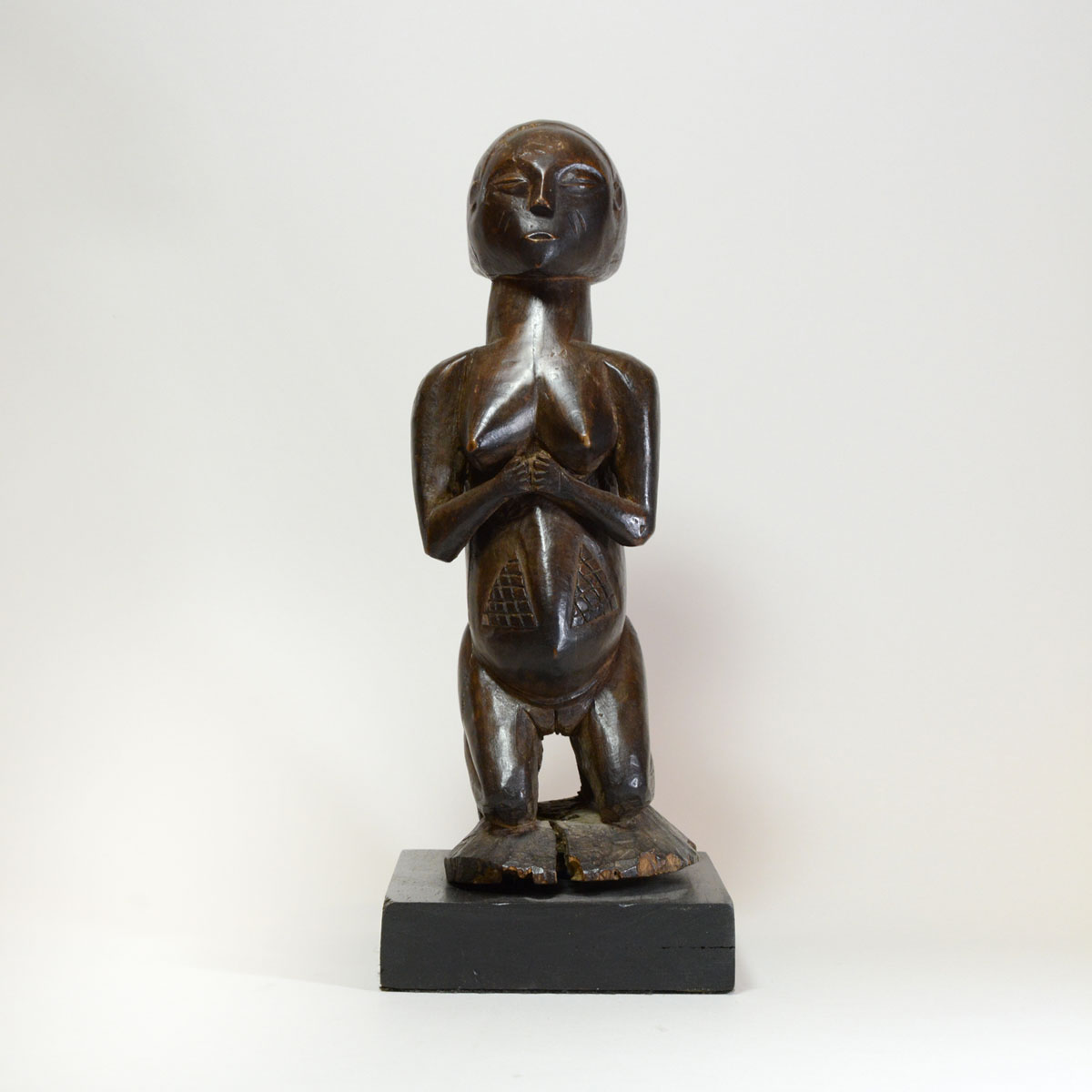
Shankadi Wooden Sculpture of a Kneeling Woman


Circa
20 th Century AD
Dimensions
13.25″ (33.7cm) high
Medium
Wood
Origin
Southeastern Congo
This elegant and sophisticated carving of a kneeling woman was made by the Shankadi people of what was once Zaire. The execution is characteristically refined and reserved, depicting the angular legs brought up under the buttocks, a defined incision at the base of the spine, a rounded back, a protuberant abdomen, small, pointed breasts with discrete nipples, and a columnar neck. The hands are brought in devoutly (?) under the breasts, the finely-carved fingers intertwined. A relief line around the hips suggests a loincloth or some other minimal apparel. The pointed stomach (which has an apex at the navel) is decorated with triangular panels of hatched designs that indicated keloid scarifications. The head is a masterwork of refinement, with coffee-bean eyes, a short, triangular nose and a pursed mouth above a sharp chin. The cheeks are marked with multiple diagonal lines which would have identified the person in life. The hair is carved in an abbreviated version of the cascade style for which the Shankadi are renowned (see below). The patina is glossy, implying long handling and usage.
The Shankadi are essentially a subgroup of the Luba peoples. They have a social system based around a hereditary chief known as a Mulohwe (who is presumably answerable to the Luba overlord, although the exact nature of their relationship is somewhat obscure. Over a million people pay tribute to the descendants of King Kongolo Maniema (who founded the dynasty in 1585), the king of the Luba. They were particularly reliant upon fishing and industries such as metalworking, leading to their status as a primary node on an ever-expanding trade network that wound its way throughout West Africa and as far as the Indian Ocean. They expanded enormously during the 18th and 19th centuries, but were seriously impacted upon by slaving missions and the rise of the Ovimbudu people of Angola; they were eventually subsumed into the Belgian Congo Empire in the early 20th century. The nature of their relationship with the immediately proximate Hemba people is still something of a bone of contention in African art circles.
They were governed by a combination of divine kingship and rule by council; the king (Mulopwe) ruled through a set of social notables who were collectively known as Bamfumus. These both controlled the Balopwe or “clan kings”, who governed designated areas as symbolic sons of the king. Social harmony and memory was controlled through the Bambudye (or Mbudye) secret society, whose members are obliged to remember and recite the whole history of the Luba people from their foundation, often using “lukasa” boards as aides-memoire. The Mbudye tradition states that all rulers of the Luba Empire traced their ancestry to Kalala Ilunga, a mystical hunter credited with toppling the cruel ruler known as Nkongolo. This figure is also credited with the introduction of advanced iron forging techniques to the Luba peoples. Aristocratic status is attained by the ability to trace one’s lineage to a founding member of the Luba people; although western academia might dismiss most of the early stages as myth, Mbudye memory scholars consider then to be the essence of truth. The king lists are especially important, as the divine status of rulers has had a notable effect on the arts and crafts of the Luba empire.
The Luba are renowned for their figures more than their masks, which are rare and usually resemble the Kifwebe masks of the Songye group. Shrine paraphernalia such as staffs, headrests, bow stands, and royal seats are known, reflecting the divine status of the ruler and the elegant refinement of his court. Carvers display incredible flexibility in terms of their representation techniques, some of which are so distinctive that pieces can be attributed to individual artists (such as the Master of Buli, one of the few historically-recognised indigenous carvers). Mwadi – female incarnations of ancient kings – are a common characteristic of Luba art, and indeed the vast majority of known sculptures depict female rather than male figures. Women also play key roles in Luba creation myths, and are strongly associated with divination (Katatora) and prestige paraphernalia. For this reason they may be carved into headrests (to capture dreams from the other world while the owner slept), stools, and prestige staffs (representing the spirit of deceased kings, carried in a woman’s body). The Shankadi are somewhat similar, although their art can often be differentiated on the basis of a cascade coiffure, which is highly exaggerated in a trefoil design by the aptly-named “Master of the Cascade”. The function of the pieces is uncertain, although they are most likely to be maternity and ancestor figures. There are three carving styles – the classical style (somewhat like the current example), the Sungu (more ornate) and southwest (more reductivist). The sparse features of the sculpture also bear some resemblance to the south-western style.
This is a refined and beautiful piece of African art.

Luba Wooden Maternity Sculpture


Circa
20th Century AD
Dimensions
6.625″ (16.8cm) high x 4.5″ (11.4cm) wide
Medium
Wood
Origin
Southeastern Congo
This serene figure is an mboko sculpture from the Luba tribe of Gabon and what was once Zaire. Portraying a sitting woman with crossed legs holding a child on her knee, this is a classic piece of Luba artwork, with a high neck, a small head, a serene face with fine detailing, and a more reductivist body with some detailing to the upper chest, arms and the child itself. The coiffure and sides of the abdomen are detailed with fine hatching which combines with the deep patina to make this a superb example of the genre.
The Luba people were once the major power in this region, with over a million people paying tribute to the descendants of King Kongolo Maniema (who founded the dynasty in 1585). Their wealth, which came from fishing and metalworking, made them ferocious traders across West Africa and as far as the Indian Ocean. They were seriously impacted upon by slaving missions and the rise of the Ovimbudu people of Angola, and were subsumed into the Belgian Empire in the early 20th century. They are very closely related to the immediately proximate Hemba people, especially in art terms.
They were governed by a divine king (Mulopwe) and a set of social notables who were collectively known as Bamfumus. The Balopwe or “clan kings” governed designated areas as symbolic sons of the Mulopwe. Social harmony and memory was controlled through the Bambudye (or Mbudye) secret society; aristocratic status is attained by the ability to trace one’s lineage to a founding member of the Luba people. The king lists are especially important, as the divine status of rulers has had a notable effect on the arts and crafts of the Luba empire.
The Luba are renowned for their figures and anthropomorphic shrine paraphernalia; carvers display incredible flexibility in terms of their representation techniques, some of which are so distinctive that pieces can be attributed to individual artists (such as the Master of Buli, one of the few historically-recognised indigenous carvers). Mboko are divination pieces, and show a kneeling or seated woman, sometimes holding a receptacle. Mwadi – female incarnations of ancient kings – are a common characteristic of Luba art, and women also play key roles in Luba creation myths, being strongly associated with divination (Katatora) and prestige paraphernalia. There are three main carving styles – Mwanza, Upemba and Mitwaba; the current piece is carved in the former, meaning that it originates in the north of the Luba territory, along the Lualaba River.
Judging from its size, this piece would have been a domestic item. It represents an ancestor, though not necessarily a female one. It has acquired a solid, glossy patina from considerable handling, and is a beautifully serene and attractive piece of African art.